Guide to Buying a Used Car – Part 1: What to Take With You
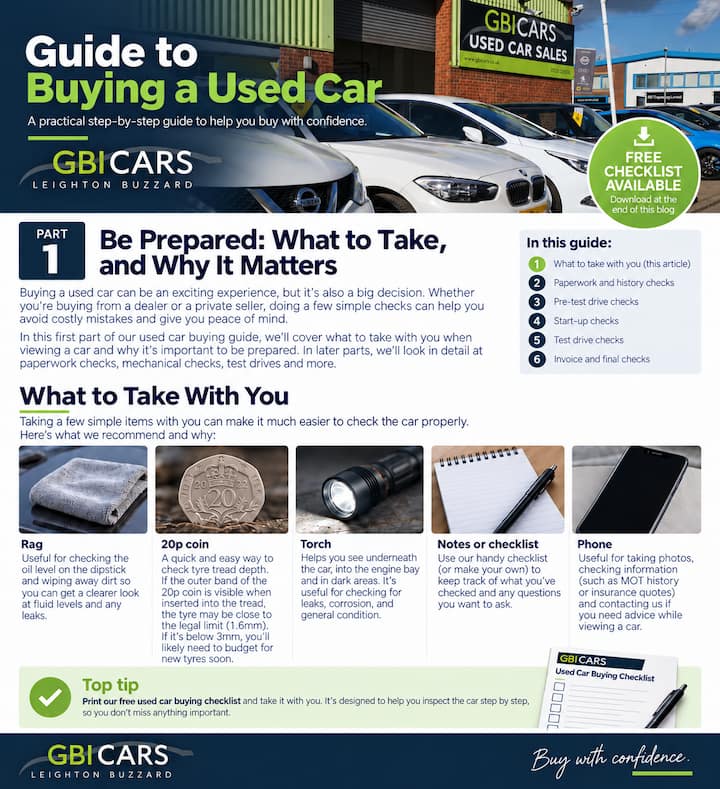
Buying a used car can be exciting, but it is also a big decision. Whether you are buying from a dealership or a private seller, taking a few simple items with you can make it much easier to check the vehicle properly and avoid costly mistakes.
At GBI Cars in Leighton Buzzard, we inspect used vehicles every day. We know that small details can tell you a lot about how a car has been maintained and whether there could be problems hiding beneath the surface.
That is why we have created our Guide to Buying a Used Car.
This is Part 1 of our six-part series, and we are starting with the basics: what should you take with you when viewing a used car?
Over the rest of the series, we will cover paperwork and vehicle history, mechanical checks, starting the engine from cold, what to look for on a test drive and the final checks to make before paying for the car.
What should you take when viewing a used car?
You do not need a toolbox or specialist diagnostic equipment to carry out some useful initial checks.
A few simple items can make a big difference.
A clean rag
Take a clean rag or some strong tissue with you.
This will be useful when checking the engine oil on the dipstick, allowing you to wipe it clean before checking the level again.
It also gives you an opportunity to look at the condition of the oil and inspect around the engine bay for signs of fluid leaks.
We will cover engine oil and fluid checks in much more detail later in this series.
A 20p coin
A 20p coin can be used as a quick indication of tyre tread depth.
Insert the coin into the main tread grooves around the tyre. If you can clearly see the outer band of the coin, the tyre may be getting low and deserves a closer inspection.
It isn’t a substitute for a proper tyre tread-depth gauge, but it is a useful quick check when viewing a car.
Even if the tyres are still legal, tyres approaching the end of their useful life could mean an additional expense shortly after buying the vehicle.
A torch
A decent torch is one of the most useful things you can take with you.
Use it to look:
• Underneath the vehicle
• Inside the wheel arches
• Around the engine bay
• Under the boot floor
• Into darker areas where leaks or corrosion might otherwise be difficult to see
Do not assume that because a car looks clean from above everything underneath will be equally tidy.
Later in the series, we will show you some of the areas worth inspecting for leaks, damage and corrosion.
Your phone
Your phone is another essential tool.
Before buying a car, you can use it to check:
• MOT history
• Insurance costs
• Vehicle specifications
• Road tax information
• Vehicle history information
It is also worth taking photographs while viewing the car.
If you notice something you are unsure about, take a picture. You can look at it properly afterwards rather than feeling pressured to make an immediate decision.
A checklist
This may be the most useful item of all.
When you are standing next to a car you like, it is surprisingly easy to forget the things you intended to check.
A checklist allows you to work through the vehicle systematically rather than relying on memory.
It also stops the excitement of buying a new car from taking over.
Don’t rush a used car purchase
One of the biggest mistakes buyers make is deciding they want the car before they have finished checking it.
Try to separate the two decisions:
Do I like this car?
and:
Is this particular example a good car to buy?
They are not the same question.
A car can be the exact model, colour and specification you wanted and still be the wrong vehicle to buy if the history, condition or mechanical checks do not add up.
Taking a few simple items with you helps slow the process down and encourages you to look at the car objectively.
What’s coming in Part 2?
In Part 2 of our Guide to Buying a Used Car, we will look at paperwork and vehicle history.
We will explain how to check:
• The V5C log book
• The VIN/chassis number
• Previous keepers
• How long the current keeper has owned the vehicle
• Service history
• MOT history
• Vehicle history checks
• The V5C/2 new keeper slip
We will also explain an important point that many buyers misunderstand:
A V5C log book is not proof of ownership.
Knowing what the paperwork should look like—and what should match the actual car—can help you spot a problem before money changes hands.
Free Used Car Buying Checklist
We are putting the key checks from all six parts of this series into one simple GBI Cars Used Car Buying Checklist that you can print and take with you when viewing a car.
It will cover everything from paperwork and tyres to engine checks, test drives and the final invoice.
[DOWNLOAD THE FREE USED CAR BUYING CHECKLIST]
________________________________________
GBI Cars – helping you buy with confidence
At GBI Cars, we believe buying a used car should be straightforward.
Whether you buy a vehicle from us or somewhere else, understanding what to check puts you in a much stronger position as a buyer.
Our aim with this series is simple: to give you practical advice that helps you recognise a good used car—and spot the warning signs of one that might not be.
Next: Guide to Buying a Used Car – Part 2: Paperwork & Vehicle History Checks